There was a jazz drummer named Peter
Whose timekeeping couldn’t be sweeter.
With sticks or with brushes
His playing was luscious
And his band mates weren’t chopped liver eit’er.
Originally published as part of a jazz concert review here.
“Once upon a time all the composition teachers in the world wrote logical music that made sense when they explained it, but sounded like pulseless beeps and farts.”
Thus begins a little fairy tale I tell for the LA Weekly, including my picks for the best classical/post-classical music concerts in Los Angeles next year. The LA Weekly story is here.
Over at Sequenza21 I expanded on the list with some more information and concert-going suggestions next year. You can read that here.
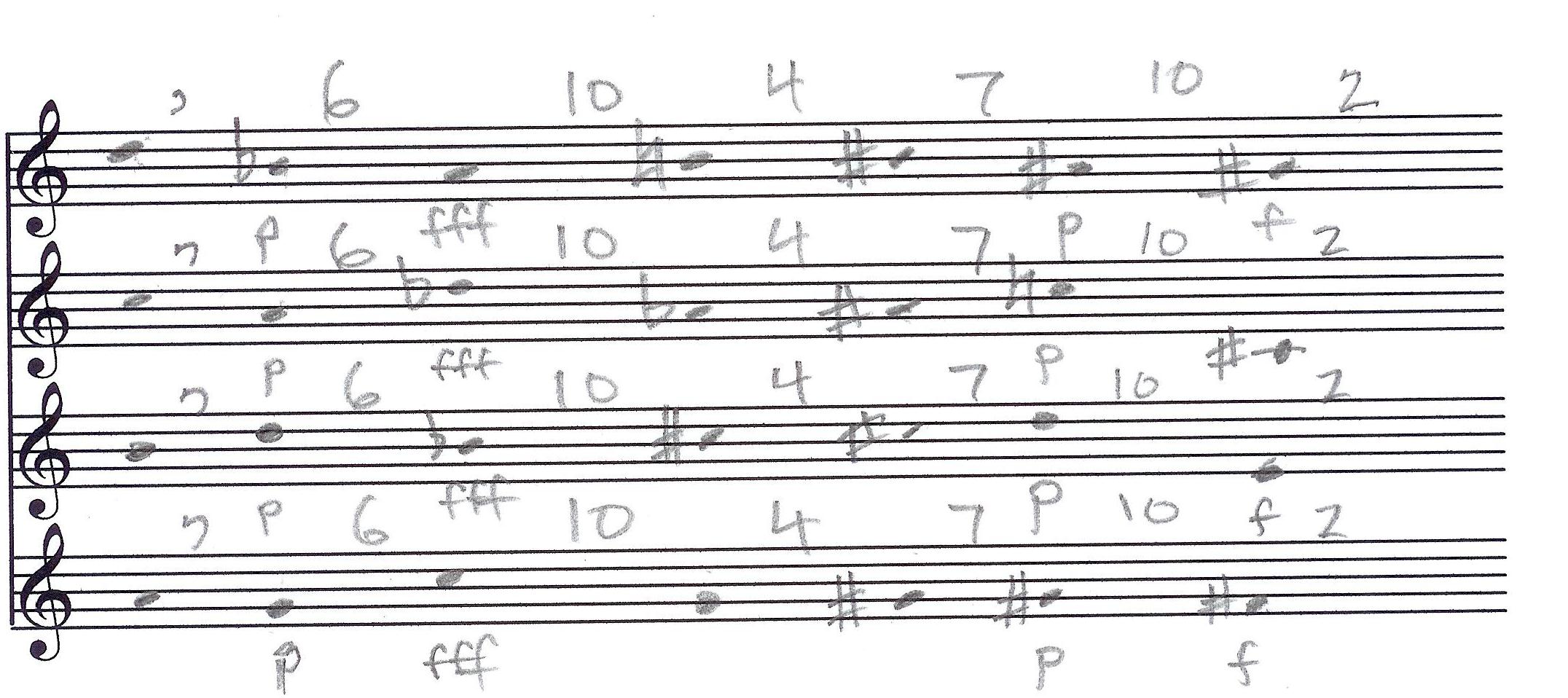
Excerpt from "It Sounds"
Yesterday was Beethoven’s birthday. I celebrated by listening to his compositions all day and evening. After the conclusion of the Pastoral Symphony, I asked myself what would Beethoven do right now? Why, compose, of course! It was 11 pm. I shut off the CD player, got out of my recliner, and headed over to the piano. I’d been working on this piece for a couple months; inspired by the industrious, painstaking example of Beethoven, I decided I could push through and finish the work.
My wife had fallen asleep on the couch, with our cat curled up on her chest. She would periodically wake up and confusedly ask, “What are you doing?” or “What’s going on?” I didn’t blame her for being so confused. Most of the chords in the piece are scalar tonal clusters, so it probably sounded to her like my fist was just dropping on keys.
“I’m composing. Do you want to go to bed?” She’d either mutter “No” or drift back to sleep without answering. Around 1:30 I helped her up off the couch so she could go to sleep. I kept going. I wasn’t really tired. By 5:30, I had pretty much completed the work. After breakfast this morning, I filled in the last few bits that I was unable to finish before I went to bed.
In honor of my inspiration last night, I grabbed the title from a program note biography of Beethoven: “It Sounds.” I had tentatively titled it “Breathoven” because each chord is played for the duration of one breath, but that looks too much like “Breath Oven” which would give listeners the wrong idea, and besides, other than inspiring me to compose, the work doesn’t really have anything else to do with Ludwig van.
Above is an excerpt from what I guess could be called a rough copy of the autograph manuscript. I still need to tweak the notation–I’ll probably use whole notes with fermatas in place of the note heads. The numbers indicate the amount (in seconds) of silence between each chord, and I’ll probably use measure rests with the numeral written above the rest in place of what I have now.

Pam Kragen, the arts editor and writer for the North County Times did a nice feature about the UCSD Toy Piano Festival this year, including a more detailed look at my world premiere on the festival. Anyone interested in the Festival or in my composition, Anything Therefore Is a Delight, may enjoy reading the questions Pam asked in August, and my emailed responses to them. I’ve edited out my blatant plugs for the show.
1. Is this the first time you’ve composed for the festival?
Scott Paulson, the director of the festival, has been asking me for a composition ever since he started the festival 11 years ago. For over a decade I wasn’t interested in composing any more concert music; I told myself if I really wanted to write anything, I’d make the time to do it. About a year ago I started composing again, and decided I would finally write the piece that Scott had requested. Part of my creative problem which resulted in a dry spell was resolved in abandoning my former techniques, and wholeheartedly embracing random procedures, which is one reason I dedicated the piece to Cage. I spent my youth trying to impose myself on the music, but when I let chance operations impose musical materials on me, I discovered the entire composition process was more pleasant. That was something that Cage’s music taught me to do, and I’m very happy with the results.
Next year will be Cage’s centennial, so I’ve dedicated the work to him, in part to celebrate his music, in part to acknowledge him for writing the first concert work for toy piano, and in part out of gratitude for providing me with the key to unlock my creativity after so many years of dormancy.
2. How many years have you been performing there (or will someone else play your piece)?
I may be wrong about this, but I recall performing at the first festival, and have played every year since, except for last year, when family matters required me to leave San Diego. I’ve played movements from the Cage Suite for Toy Piano, which is always fun. One of the highlights of my performance history there was premiering a duet for toy pianos composed by Pea Hicks. Scott also does a concert series at Geisel Library which predates the Toy Piano Festival. It’s the Short Attention Span Series, and I’ve been able to play a wide range of music—popular and classical from all periods—at those concerts.
I’ll play my own work for the Festival next week. Each performance will consist of different movements (there are five total); we’ll ask audience members to select movements, which I hope to shape into the most compelling interpretation I can muster on the spot.
3. Is there any special compositional technique you must use to compose for a toy piano?
From years of playing toy pianos in public, I have a strong understanding of their limitations, and I’ve tried to avoid those. First of all, the tuning from one instrument to the next is always different, so you have to accept that the E-flat you hear on a Yamaha piano will not be the same E-flat a Schoenhut toy piano produces. The toy piano has a limited dynamic range, so extreme or subtle dynamics for the instrument do not translate well. A performer has no control over cutting off a note on the toy piano, unless they reach inside the instrument and damp the metal rod to cut off the sound.
I don’t think harmonies work very well on the instrument. It’s difficult to tell the quality of a chord. If a composer wanted to exploit that, I suppose they could. I chose to write mainly in two-part textures, which I think the instrument negotiates much better than working with chords. My piece takes all of those considerations into account.
There are other ways of playing the instrument (I mentioned reaching inside to stop note), but I limited myself to writing notes played in a traditional manner on the keyboard. Someone wrote a toy piano fanfare which Scott Paulson usually plays each year, in which he lifts the piano up and shakes the whole instrument back and forth, which produces an eerie vibrato. Maybe next year, for the centennial, I’ll play Cage’s Music for Amplified Toy Pianos. It’s one of his graphically notated scores, and calls for pizzicato (plucking the metal rods with the fingers), electronic “noises” (Cage doesn’t specify what those are, so there’s leeway in interpretation), and percussive effects.
4. How many people come out for the festival each year?
Dozens. I’d guess at least a hundred. It’s always full, with people sitting on the stairs and standing in the halls because there aren’t enough chairs to accommodate everyone.
5. Tell me about your piece.
When I was a composition student 30 years ago, many young American classical musicians had no interest in playing modern music, and so I always wrote with the understanding that everything needed to be spelled out for an interpreter. These days young performers have a far greater awareness of contemporary compositional trends, so now I’m interested in giving performers less directions in my music and seeing what they come up with. If you look at Baroque music, usually there’s little more than pitches and rhythms notated. You rarely see marks to indicate phrasing and articulation or dynamics, and often there’s no tempo marking. Nevertheless, performers bring their musical instincts and apply their analytical skills to these works and produce beautiful realizations. I’m striving for the same relationship with performers. I want them to put themselves into the notes, so it will be a genuine collaboration.
Anything Therefore is a Delight is a suite composed of 5 movements. The titles of the suite and the individual movements were taken from John Cage’s first book of essays and anecdotes, Silence. There are no interpretive markings in the music except for a few places where I want the music to breathe a little, or slow down. A performer selects the movements and the order in which they are played. There are correspondences from movement to movement, so it’s important that at least two of the movements are programmed in a performance. I also allow performers to repeat one of more movements, so the overall length will be determined by the performer’s preferences.
As a young composer and listener, I was very impressed with logic and order in music. As I’ve gotten older, I’ve opened myself up to irrationality as an equally compelling force. Debussy; Satie; Cage; John Zorn; Takemitsu; Howard Skempton: these composers wrote (or write) music which resists analysis. How does Debussy take you along in his later works without ever giving you a full tune? Every time you think you’re about to get an honest-to-God melody, he lets it unravel and moves onto something else. Pop ditties interrupt classical textures in Debussy, Satie, and Zorn. Why does one chord follow another in Skempton’s music, or one musical texture follow another in Takemitsu? I can’t tell you, but there’s something magical in how these composers play with your expectations. I’m trying to discover those same kinds of fantastical connections that these composers make, musical choices that appear illogical on paper, but sound perfectly right to your ears.
Video excerpt of me premiering “Anything Therefore is a Delight”

John Cage performing his Suite for Toy Piano
I also gave Pam a bonus anecdote about John Cage:
My senior year at the University of Michigan School of Music, I took a field trip with a small group of composers to hear John Cage perform in Detroit. This was in 1983. After his performance (not really musical—he read one or more of his mesostics about Satie, Joyce, and Thoreau), he fielded questions from the audience. I stood up and asked him, “What advice would you give to a young composer?” He pondered that for at least minute, pacing back and forth on stage with his head down. After what seemed an uncomfortably long time, he stopped, looked up at me, and said, “I would tell him or her to do what they believe in.”
I was disappointed with his response. It seemed so obvious as to be above stating. I remember asking myself, “That’s all he could come up with?”
A decade later, after far too many years of sparring with my peers and navigating and negotiating from one teacher to another, winding up thoroughly confused and creatively exhausted, it dawned on me that Cage had given me the very best advice I had ever received about composing.
An earlier blog post of mine discusses how I chose the title of my toy piano suite and its movements.
A little Halloween mischief courtesy of my cat Max and Alban Berg
Twitter had a #YoMomma hashtag (is that redundant?) going the other night. Now how could I resist posting a couple?
- Yo Momma so fat, flesh-eating bacteria passed her by because they want to enjoy their meal before they die
- Yo Momma so dumb, she thinks Facebook is something that Ed Gein keeps on his coffee table
- Yo Momma so ugly, Stevie Wonder gouged his eyes out just in case his sight ever returns
- Yo Momma so smelly, when she walks through Dog Park, people shout at Great Dane owners, “Hey, scoop up your mess!”
- Yo Momma so horny, when she approaches a candle store, the owner locks the door and hangs up an “Out To Lunch” sign
- Yo Momma so fat, she has to go to Shamu’s tank at Sea World to take a dump
- Yo Momma so inbred, she calls her grandma “Sis”
- Yo Momma so ugly, when she yawns, people cry out, “Hey, look, it’s the Goatse.cx man!” (Seriously, you don’t understand that reference? You’re one of the 3 people who missed that website? I never post disclaimers, but this is not safe for work or children. Get yourself a bucket of sand to scrub your corneas for the rest of the day, and click here if you absolutely have to see it.)
- Yo Momma so fat she got her own Occupy protest
Finally, I think I created the very first “Yo Momma so lactose-intolerant…” joke:
- Yo Momma so lactose-intolerant she get hives reading Victoria’s Secret catalogs
You’re welcome!
When I was a young composer, I entered lots of competitions. You send in a manuscript, sometimes with a recording, but it has to be anonymous, so you cover up your name on the manuscript with a fake one for identification purposes. For the longest time, my pseudonym was “Joe Momma.” And I wonder why I never won anything.
(I later switched my contest pseudonym to “No. 6.” The very first pseudonym I ever used was “Fats Waller,” which I thought was hilarious because the composition I was submitting was a brooding atonal, arrhythmic work. Looking back on my choice of pseudonyms decades later, I went from absurdity; to a lengthy period of insulting the judges; then finally to a name which suggested I was being persecuted–although at the time I swear I was just being goofy.)
Insulting another person’s mother can have serious consequences. Men routinely insult their best friends as a form of respect and competition. However, extreme caution should be exercised if the target of the insult moves from one’s friend to their mother, sister, girlfriend, or wife. If it’s not completely clear to both parties that they are entering a game of the dozens, violence may ensue.
The gang I hung around with in college freely indulged in insults to one’s self, one’s immediate family, and one’s girlfriend. A standard form of greeting between us would be, “Hey, how’s your mother in bed?” (The conversation usually got filthier from that point, sometimes ending in elaborate scenarios which resembled, unbeknownst to us, a telling of The Aristocrats joke.) The important thing to understand is that this was an established code of behavior between us. No blood would be shed because of something outrageous one of us said to the other.
So one night, I’m partying with my crowd in my buddy’s dorm room. There were a few folks from the hall floor with us as well, guys that I had met at other parties or in the cafeteria or rec room and had spoken with before. So one of these acquaintances from outside my trusted circle of nasty-tongued buddies stood at the door saying bye to everyone. When he got to me, he said, “Good night, Ugly.” No sooner had he insulted me, than I shot back, “Ahhhh, your mother’s a whore.”
His demeanor immediately changed. Every muscle in his body tensed up, he scowled and took about three long strides across the room towards where I was seated. By the time he got to me, his arm shot out and grabbed my collar and twisted the fabric until it bit down into my neck.
“Take it back!” he yelled, his face red, choking me even more as he brought up his other hand.”All right! All right!” the words somehow escaped from my gradually-constricting windpipe. “I take it back! I’m sorry. She’s not a whore!”
Eventually he loosened his grip, walked to the door, and whipped around before stepping outside, jabbing his index finger at me from across the room, yelling “DON’T YOU EVER SAY ANYTHING ABOUT MY MOTHER AGAIN!” and then left the room for the rest of the night. I think that if I had piled another mother joke on top of the unsophisticated one I first threw at him, I would have ended up in the emergency room that evening–or the morgue.
I learned a valuable lesson that day: Never insult an acquaintance’s mother, sister, or girlfriend unless I am absolutely sure that they can take the insult in the sporting manner of camaraderie in which it is intended. And never, ever insult a stranger.
Last year I made a cartoon consisting of two characters playing the dozens. It’s pretty easy to do this courtesy of Xtranormal, and I thought it came out well enough, although I should have spent more time picking better jokes (I just used time-tested ones for the dialogue). Still, hang around for the punch line.
“Take my word for it–ten or eleven wives is all you need–never go over it.”–attributed to Brigham Young

The Wall Street Journal reports that an Indian man named Ziona, with 39 wives and 94 children, is the father of the largest family in the world. You can see plenty of photos of Ziona and some of his wives and children here.
I was tempted to do some comic riffing on Ziona’s family, but I have nothing to add that Mark Twain did not observe about the most famous large family of his day, the household of Brigham Young. I will defer to Twain’s story, because, to paraphrase Fats Waller’s comment on Art Tatum, “I just tell jokes–today God is in the house.”
This is an excerpt from Chapter 15 of Twain’s travel/adventure book, Roughing It, describing his wanderings across the Western states and territories from 1861-1867.
According to these Gentile friends of ours, Brigham Young’s harem
contains twenty or thirty wives. They said that some of them had grown
old and gone out of active service, but were comfortably housed and cared
for in the henery–or the Lion House, as it is strangely named. Along
with each wife were her children–fifty altogether. The house was
perfectly quiet and orderly, when the children were still. They all took
their meals in one room, and a happy and home-like sight it was
pronounced to be. None of our party got an opportunity to take dinner
with Mr. Young, but a Gentile by the name of Johnson professed to have
enjoyed a sociable breakfast in the Lion House. He gave a preposterous
account of the “calling of the roll,” and other preliminaries, and the
carnage that ensued when the buckwheat cakes came in. But he embellished
rather too much. He said that Mr. Young told him several smart sayings
of certain of his “two-year-olds,” observing with some pride that for
many years he had been the heaviest contributor in that line to one of
the Eastern magazines; and then he wanted to show Mr. Johnson one of the
pets that had said the last good thing, but he could not find the child.He searched the faces of the children in detail, but could not decide
which one it was. Finally he gave it up with a sigh and said:“I thought I would know the little cub again but I don’t.” Mr. Johnson
said further, that Mr. Young observed that life was a sad, sad thing–
“because the joy of every new marriage a man contracted was so apt to be
blighted by the inopportune funeral of a less recent bride.” And Mr.
Johnson said that while he and Mr. Young were pleasantly conversing in
private, one of the Mrs. Youngs came in and demanded a breast-pin,
remarking that she had found out that he had been giving a breast-pin to
No. 6, and she, for one, did not propose to let this partiality go on
without making a satisfactory amount of trouble about it. Mr. Young
reminded her that there was a stranger present. Mrs. Young said that if
the state of things inside the house was not agreeable to the stranger,
he could find room outside. Mr. Young promised the breast-pin, and she
went away. But in a minute or two another Mrs. Young came in and
demanded a breast-pin. Mr. Young began a remonstrance, but Mrs. Young
cut him short. She said No. 6 had got one, and No. 11 was promised one,
and it was “no use for him to try to impose on her–she hoped she knew
her rights.” He gave his promise, and she went. And presently three
Mrs. Youngs entered in a body and opened on their husband a tempest of
tears, abuse, and entreaty. They had heard all about No. 6, No. 11, and
No. 14. Three more breast-pins were promised. They were hardly gone
when nine more Mrs. Youngs filed into the presence, and a new tempest
burst forth and raged round about the prophet and his guest. Nine
breast-pins were promised, and the weird sisters filed out again. And in
came eleven more, weeping and wailing and gnashing their teeth. Eleven
promised breast-pins purchased peace once more.“That is a specimen,” said Mr. Young. “You see how it is. You see what
a life I lead. A man can’t be wise all the time. In a heedless moment I
gave my darling No. 6–excuse my calling her thus, as her other name has
escaped me for the moment–a breast-pin. It was only worth twenty-five
dollars–that is, apparently that was its whole cost–but its ultimate
cost was inevitably bound to be a good deal more. You yourself have seen
it climb up to six hundred and fifty dollars–and alas, even that is not
the end! For I have wives all over this Territory of Utah. I have
dozens of wives whose numbers, even, I do not know without looking in the
family Bible. They are scattered far and wide among the mountains and
valleys of my realm. And mark you, every solitary one of them will hear
of this wretched breast pin, and every last one of them will have one or
die. No. 6’s breast pin will cost me twenty-five hundred dollars before
I see the end of it. And these creatures will compare these pins
together, and if one is a shade finer than the rest, they will all be
thrown on my hands, and I will have to order a new lot to keep peace in
the family. Sir, you probably did not know it, but all the time you were
present with my children your every movement was watched by vigilant
servitors of mine. If you had offered to give a child a dime, or a stick
of candy, or any trifle of the kind, you would have been snatched out of
the house instantly, provided it could be done before your gift left your
hand. Otherwise it would be absolutely necessary for you to make an
exactly similar gift to all my children–and knowing by experience the
importance of the thing, I would have stood by and seen to it myself that
you did it, and did it thoroughly. Once a gentleman gave one of my
children a tin whistle–a veritable invention of Satan, sir, and one
which I have an unspeakable horror of, and so would you if you had eighty
or ninety children in your house. But the deed was done–the man
escaped. I knew what the result was going to be, and I thirsted for
vengeance. I ordered out a flock of Destroying Angels, and they hunted
the man far into the fastnesses of the Nevada mountains. But they never
caught him. I am not cruel, sir–I am not vindictive except when sorely
outraged–but if I had caught him, sir, so help me Joseph Smith, I would
have locked him into the nursery till the brats whistled him to death.
By the slaughtered body of St. Parley Pratt (whom God assail!) there
was never anything on this earth like it! I knew who gave the whistle to
the child, but I could, not make those jealous mothers believe me. They
believed I did it, and the result was just what any man of reflection
could have foreseen: I had to order a hundred and ten whistles–I think
we had a hundred and ten children in the house then, but some of them are
off at college now–I had to order a hundred and ten of those shrieking
things, and I wish I may never speak another word if we didn’t have to
talk on our fingers entirely, from that time forth until the children got
tired of the whistles. And if ever another man gives a whistle to a
child of mine and I get my hands on him, I will hang him higher than
Haman! That is the word with the bark on it! Shade of Nephi! You don’t
know anything about married life. I am rich, and everybody knows it. I
am benevolent, and everybody takes advantage of it. I have a strong
fatherly instinct and all the foundlings are foisted on me.“Every time a woman wants to do well by her darling, she puzzles her brain
to cipher out some scheme for getting it into my hands. Why, sir, a
woman came here once with a child of a curious lifeless sort of
complexion (and so had the woman), and swore that the child was mine and
she my wife–that I had married her at such-and-such a time in such-and-
such a place, but she had forgotten her number, and of course I could not
remember her name. Well, sir, she called my attention to the fact that
the child looked like me, and really it did seem to resemble me–a common
thing in the Territory–and, to cut the story short, I put it in my
nursery, and she left. And by the ghost of Orson Hyde, when they came to
wash the paint off that child it was an Injun! Bless my soul, you don’t
know anything about married life. It is a perfect dog’s life, sir–a
perfect dog’s life. You can’t economize. It isn’t possible. I have
tried keeping one set of bridal attire for all occasions. But it is of
no use. First you’ll marry a combination of calico and consumption
that’s as thin as a rail, and next you’ll get a creature that’s nothing
more than the dropsy in disguise, and then you’ve got to eke out that
bridal dress with an old balloon. That is the way it goes. And think of
the wash-bill–(excuse these tears)–nine hundred and eighty-four pieces
a week! No, sir, there is no such a thing as economy in a family like
mine. Why, just the one item of cradles–think of it! And vermifuge!
Soothing syrup! Teething rings! And ‘papa’s watches’ for the babies to
play with! And things to scratch the furniture with! And lucifer
matches for them to eat, and pieces of glass to cut themselves with!
The item of glass alone would support your family, I venture to say, sir.
Let me scrimp and squeeze all I can, I still can’t get ahead as fast as I
feel I ought to, with my opportunities. Bless you, sir, at a time when I
had seventy-two wives in this house, I groaned under the pressure of
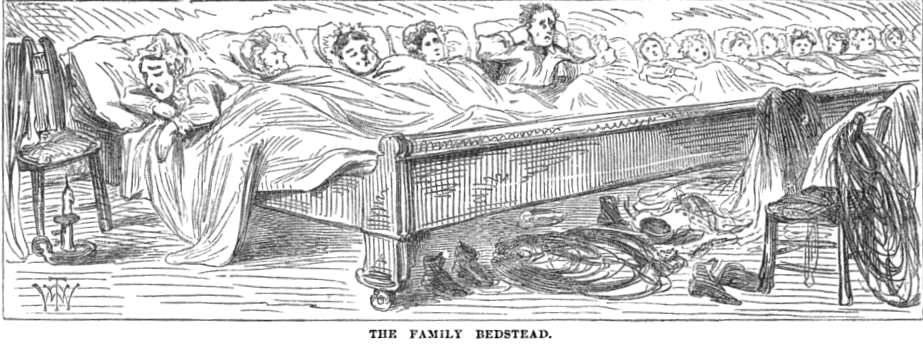
keeping thousands of dollars tied up in seventy-two bedsteads when the
money ought to have been out at interest; and I just sold out the whole
stock, sir, at a sacrifice, and built a bedstead seven feet long and
ninety-six feet wide. But it was a failure, sir. I could not sleep.
It appeared to me that the whole seventy-two women snored at once.
The roar was deafening. And then the danger of it! That was what I was
looking at. They would all draw in their breath at once, and you could
actually see the walls of the house suck in–and then they would all
exhale their breath at once, and you could see the walls swell out, and
strain, and hear the rafters crack, and the shingles grind together.
My friend, take an old man’s advice, and don’t encumber yourself with a
large family–mind, I tell you, don’t do it. In a small family, and in a
small family only, you will find that comfort and that peace of mind
which are the best at last of the blessings this world is able to afford
us, and for the lack of which no accumulation of wealth, and no
acquisition of fame, power, and greatness can ever compensate us.
Take my word for it, ten or eleven wives is all you need–never go over
it.”Some instinct or other made me set this Johnson down as being unreliable.
And yet he was a very entertaining person, and I doubt if some of the
information he gave us could have been acquired from any other source.
He was a pleasant contrast to those reticent Mormons.
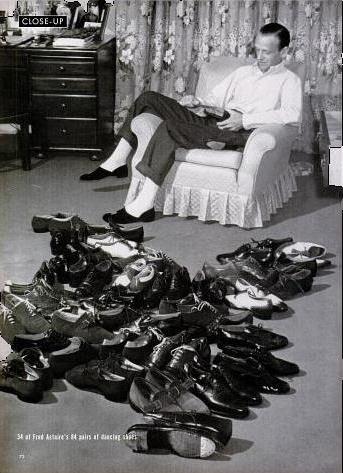
My friends Mark and Lynn were in the road show company of My One and Only (Tommy Tune headlined on the road–nice, huh?). Many celebrities would come to pay their respects.
One day Fred Astaire came backstage. One of the dancers in the cast shouted out, “You’re the reason we’re here.”
Mr. Astaire replied, “You’re the reason I did it.”
Peas
by John Wayne Gacy
I eat my peas with honey,
I’ve done it all my life.
It might sound rather funny,
But it covers up the stench of the bodies buried in the crawlspace.

.
.
.
If you enjoyed that, you may be amused by this limerick.
I’m always writing jokes in the margins of my books, and then I pick the book up after 20 years and see something I had completely forgotten I’d written, and it just kills me. For instance, last weekend I opened my dictionary to look up the word “percipient” and saw this instead:
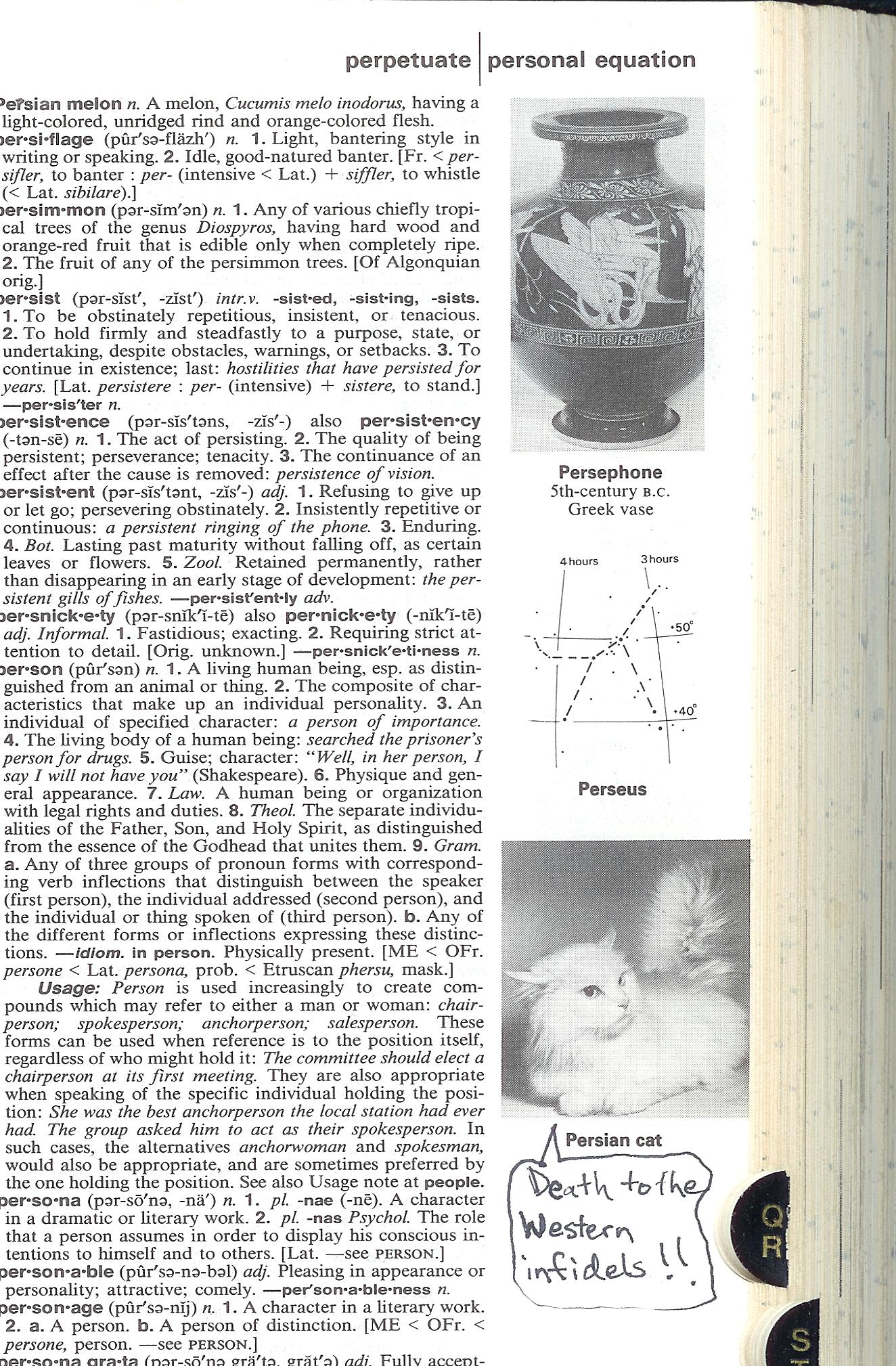
(It’s an old dictionary.)
So imagine my surprise when I viewed this list of wisenheimer responses to signs which has been forwarded around the Internet lately, and discovered something I had written and then completely forgotten:
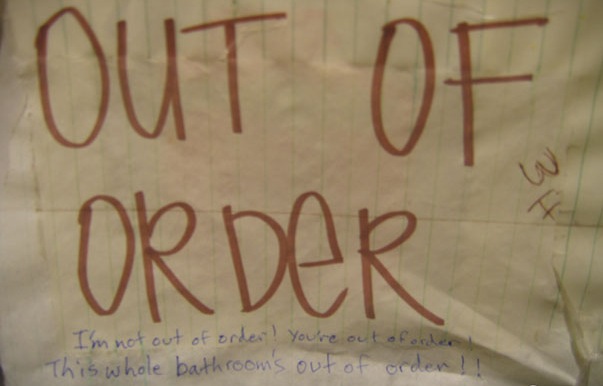
My epitaph should read, “Gave Away All His Best Material For Free”

 Bloghead