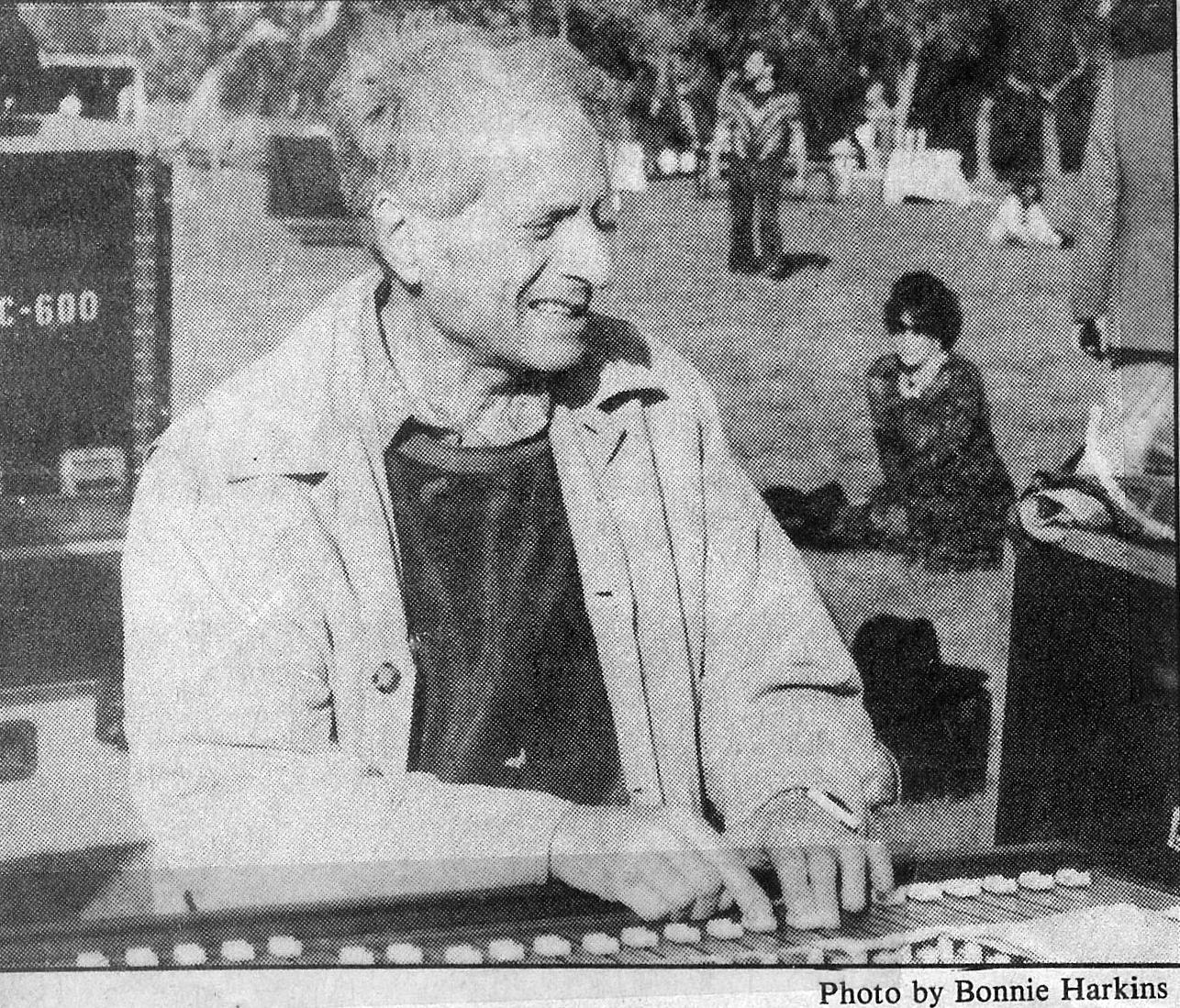
Iannis Xenakis mans the faders for a performance of La Legende D'Eer in San Diego, Apr. 1990
In 1990, the UC San Diego Music Dept. sponsored a week-long festival of music, discussions, and presentations by and about Iannis Xenakis. It was the most memorable festival the Music Dept. presented during my time there.
I had been a freelance reviewer for all of 6 weeks when I wrote this roundup of the festival, but I hope the snapshot of this historical event outweighs the banality of my prose at the time.
At the time, I was using the pseudonym of Adam Prasser for my reviews, a tactic I thought necessary to allow me to speak with candor about the colleagues, professors, and people controlling my grad school funding. (It worked for a while). An even graver journalistic sin was reviewing a performance in which I took part (Ais). You can occasionally hear my piano playing rising above the walls of sound from that performance on this CD.
My editor at the La Jolla/University City Light was always generous in providing me column space, but I crossed the line with this review, and found my words cut. Below I have restored the original copy submitted to my editor. The photo above accompanied my story in the Light.
Xenakis Brings Musical Genius to UCSD
University City Light, Apr. 19, 1990
Iannis Xenakis, the distinguished European avant-garde composer, was in residence at UCSD from April 3-9. Made possible primarily through the support of local arts patron Muriel Gluck, the residency was noteworthy in two ways.
As part of his residency, Xenakis coached musicians in performances of his music; the concert schedule was purportedly the largest program ever devoted entirely to Xenakis’ works. Most of the works performed were local premieres; several of them had never been performed (or heard, as they have not been recorded) in this country before.
The presence of Xenakis himself throughout the entire festival provided San Diegans a personal glimpse of a musical genius. In two informal talks presented during the two main concerts at Mandeville Auditorium on April 4 and 7, and moderated by Roger Reynolds, the festival’s organizer, Xenakis revealed himself to be a committed, hard-working composer, an honest craftsman who builds impressive edifices of sound. He also seemed surprisingly modest for someone who has been a perceived leader of the European avant-garde since the 1950’s.
Although Xenakis is best known for his application of mathematical models to his music, these talks revealed him as a humanist as well. Citing writers as diverse as Plato, Shelley, and Pascal in his discussions, Xenakis emphasized the necessity for music to capture emotional and intuitional truths. Most of the music heard on these two concerts seemed to do exactly that.
The April 4 concert began with a performance of two violin solos, Mikka (1971) and Mikka S (1976). In much of his string writing since the ’60’s, Xenakis has developed a new style of playing which emphasizes glissandi and a clear, vibratoless tone. Janos Negyesy performed these works admirably, although an overhead camera picking up his hand movements and projecting them on a large screen at the back of the stage seemed more distracting than enlightening, making an otherwise wonderful performance redolent of rock concert glitz.
Last month I raved about Thallein (1984), premiered by SONOR. A second hearing confirmed my belief that this is a contemporary chamber orchestra masterpiece. SONOR provided an extremely tight and powerful rendition of the work, obviously being more comfortable with it now that they had had several opportunities to perform it.
Heather Buchman, principal trombonist with the San Diego Symphony, was on hand for the U.S. premiere of a solo trombone piece, Keren (1986). This work revealed a surprisingly lyrical facet to Xenakis, but was couched in virtuosic writing, requiring Buchman to quietly leap back and forth between two and sometimes three different registers of her instrument. Buchman also performed mute changes by inserting the bell of her trombone into one of two mutes mounted on mike stands. Despite the virtuosity, novelty, and unexpected lyricism, Keren struck this critic as an ultimately uninvolving piece which overstayed its initial welcome.
After a slide show (unaccompanied by music or narration) of architectural projects Xenakis had designed or co-designed, the UCSD Men’s Chorus, conducted by Philip Larson, presented the American premiere of A Colone (1977). Accompanied by three trombones, three horns, three cellos, and two contrabasses, the chorus delivered the fifth-century Attic text in a declamatory fashion. The rhythms of the vocal line were apparently based on the text’s inherent speech rhythms, so the meter was consequently asymmetrical and shifting. The brass mainly played dramatic sustained tones in unison. The overall effect of the work was that of a contemporary revision of an ancient subject, but one in which all of the nobility and grandeur of the original was captured in its retelling. For a composer whose reputation was built on the use of “sound masses” in his composition, Keren and A Colone were unexpectedly melodic, and even, (dare I say?) traditional-sounding.
The next concert on Sat. Apr. 7, revealed more of the avant-garde side of Xenakis. The concert opened with a highly engaging performance of Psappha (1975) by solo percussionist Steven Schick. In Psappha, there are no melodies, and since the dynamic level is consistently fortissimo throughout, Xenakis relies entirely on rhythm and tone color as his compositional building blocks. The work is full of driving, relentless streams of notes; Schick maintained the high energy level throughout the piece, even during an extended kick drum solo before the climactic ending. Psappha was to rock drumming what James Joyce is to Danielle Steele.
The next work was Mycenes Alpha (1978), an electronic composition composed on a computer device designed by Xenakis that enables images drawn on a screen to be converted into sound. As the work was performed, slides of the score itself were displayed on a screen, allowing the audience to “see” the music they were hearing. As the images themselves were frequently complex networks of branches, or arrays of gradually changing lines, so too did the music reflect this. It often consisted of broad, sweeping gestures, paralleling the curves formed by dozens of lines in the score. It was a work which revealed new vistas in sound, a defiantly Modern piece, proud of its abrasiveness, and yet ultimately uplifting if you were willing to follow Xenakis’ sonic landscapes.
The first half concluded with a performance of N’Shima (1975), for two altos, two horns, two trombones, and cello, ably conducted by Keith Humble. Constance Lawthers and Ann Chase sang their demanding parts with authority and panache. The title is a Hebrew word meaning “exhalation,” and towards the end of the piece, the altos are literally exhaling in rhythm. An obsessive pulse underlies the music as the different pairs engage in otherworldly two-part counterpoint. At times these pairs collide with each other, forming four- and six-part textures. According to the program notes, all of these melodies were derived from a model based on the Brownian motion of particles, and they did reflect this model. An individual melody would deviate from a starting note, but would return after wandering around this note. The cello mainly performed by itself during interludes with a sliding, vibrato-less style reminiscent of Mikka; Ron Robboy was an earnest cellist, sensitive to the new technical demands Xenakis placed upon him. N’Shima was a compelling, ear-opening work.
The second half of the concert opened with two small gems, Pour Maurice, (1982) zestfully performed by Philip Larson, baritone, and Alan Feinberg, piano, and a r. (Hommage a Ravel), (1978) a dazzling virtuosic occasional piece played by Feinberg. The highlight of the evening was the concluding work on the concert, Ais.
Ais is a musical descent into hell. In this work for orchestra, percussion solo, and baritone, Xenakis conveys the agony and grief of the damned with unflinching accuracy. Philip Larson, the vocal soloist, performed his difficult part with the requisite underscoring of pain and suffering, alternating between falsetto howls and dark, sombre funereal chanting. Steven Schick, solo percussionist, provided a mad, obsessive counterpoint to Larson’s lamentations and the orchestra’s shrieks and growls. Underpinning most of Ais is a relentless, propulsive momentum which culminates after nearly 20 minutes of extreme intensity in a low, rumbling wash of sound which gradually subsides. Once again, Tom Nee and the La Jolla Civic/University Symphony Orchestra have successfully tackled a difficult piece which most professional orchestras in this country would not touch. Ais was a gripping, dramatic piece, and the audience wildly applauded the soloists, orchestra, and the composer.
A third concert took place on the lawn outside the Salk Institute at 5 PM on Sunday, April 8. The first work was the American premiere of Voyage Absolu des Unari Vers Andromede (1989) for electronic sounds and kites. Against a cloud-spotted sky, with hang-gliders hovering in the distance, three sets of kites were launched. One remained fairly stationary throughout most of the piece, but the other two traced spirals above the audience’s heads in an improvised choreography to the swoops and trajectories of the tape part. Many of the sounds were similar to those used in Mycenes Alpha; both works were realized on the same computer system. In a brief program note, Xenakis wrote that “the piece is about cosmic travel in a distant future toward the galaxy of Andromeda.” While the tape part did not seem all that extraordinary if it would have been presented by itself, the combination of electronic sounds, dancing kites, and the unusual concert venue was novel and infectiously magic.
When the tape part was over, the kites sharply landed, and after a brief pause, Steven Schick launched into a performance of Rebonds a and b (1987-89). Unlike Psappha, Rebonds had a wide dynamic range, and one could hear actual rhythmic motives which were developed in a more traditional fashion (although the idea of a solo percussion piece is undoubtedly untraditional to many). The percussion set-up was amplified, and different instruments were panned to different speakers surrounding the audience. As Schick demonstrated the previous evening, he is an engaging performer who uses his entire body when performing in a sort of graceful choreography. It is a credit to Xenakis’ genius that he could fill twelve minutes worth of time with such delightful writing for non-pitched percussion.
After a break for a picnic dinner on the lawn, the audience reconvened for a performance of La Legende D’ Eer. Xenakis sat at the mixing console, manipulating the faders as seven channels of electronic sounds dispersed from a circle of speakers enveloped the audience. This work was inspired by a brief episode from Plato’s Republic in which a soldier, Eer, describes how he was taken from the land of the living and shown the supernatural world, only to be returned.
The music reflected this program in its beginning, with its long, sustained sine-wave-like tones gradually transmuting into something sounding like cicadas chirping; at the work’s end, the cicada-like chirps become the long, sustained tones. The core of the work, however, is a forty-minute long exposition through the “supernatural world,” represented here by sounds ranging from bricks being struck together to African musical instruments, all of which are frequently distorted to the point where the listener can just barely make out the original sound source. This supernatural world is filled with gradual transitions from certain families of sounds to others. It is a work that demanded patience, for the changes were slow; however, there was enough rich detail in the more static sections of the piece to reward the listener willing to concentrate on them.
As the piece progressed, the sun gradually set, and it became darker and colder, these changes occurring on the slow, gradual time scale of the work itself. These were fitting changes to accompany Xenakis’ musical journey through another reality. Audience members got out of their chairs and walked about to hear different channels. Many were smiling in wonder of the sonic journey they were taking.
La Legende D’ Eer was in many ways the most challenging work presented on the festival. Its abandoning of such musical devices as melody, harmony, and discernable rhythms would not seem like music to many people. But the audience at this concert was a specialized one, appreciative of Xenakis’ innovations and eager to follow him, like Eer, into new worlds. When the work was over, the audience, many of whom were shivering from the cold, savored the silence for a minute or so. Then they burst into enthusiastic applause, a lengthy applause which seemed to embarrass Xenakis, who humbly accepted his heart-felt accolades with a shy flip of the wrist and nod of the head.
-
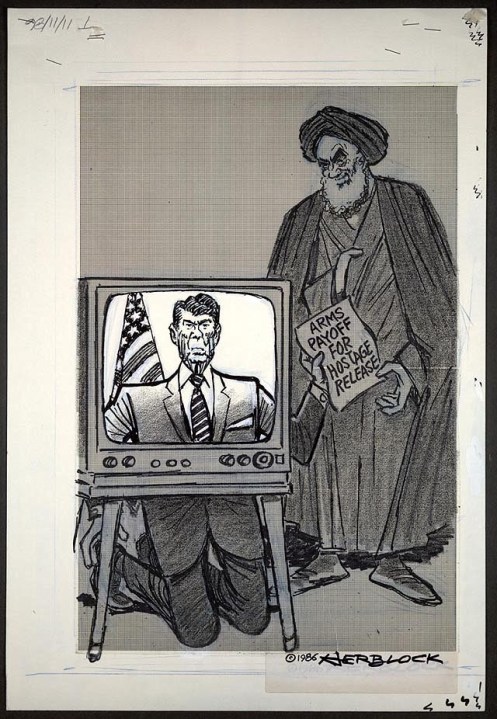
Even stranger was selling drugs to buy weapons for the Nicaraguan Contras
As we celebrate Ronald Reagan’s centennial, let’s not forget the leadership he provided to America, setting a standard for every sad-ass president since.
Pundits accused Bill Clinton of flip-flopping. Well, Slick Willie was only following in the footsteps of the Great Equivocator, Ronald Reagan.
Remember the Iran-contra scandal? Observe with wonder how Ronald Reagan answered questions and issued statements which clarified his administration’s involvement in negotiating with terrorists, the one thing Reagan said the United States never, ever did.
- “We did not–repeat, did not–trade weapons or anything else for hostages, nor will we.” 11/13/86
- “To eliminate the widespread but mistaken perception that we have been exchanging arms for hostages, I have directed that no further sales of arms of any kind be sent to Iran.” 11/19/86
- “Let me just say it was not my intent to do business with Khomeini, to trade weapons for hostages, nor to undercut our policy of anti-terrorism.” 12/6/86
- “A few months ago I told the American people I did not trade arms for hostages. My heart and my best intentions still tell me that’s true, the facts and evidence tell me it is not.” 3/4/87
- “It sort of settled down to just trading arms for hostages, and that’s a little like paying ransom to a kidnapper.” 3/26/87
Was he confused or lying through his teeth? Either possibility remains depressing.

I’m a liberal, and I don’t have much regard for the Tea Party. Anyone who puts some effort into making a protest sign about “torte reform” or “tyrrany” for a congresswoman’s viewing does not win any respect from me. I think Matt Taibbi analyzed the movement in this devastating article in Rolling Stone much better than I can do here; what I would like to comment upon is the characterization of Tea Party members as “teabaggers.”
For the time being, let’s leave aside the inconvenient fact that colonists in Boston, who supposedly are the inspiration for the Tea Party movement, brewed their tea using loose leaves (tea bags weren’t invented until the early 20th century). That doesn’t stop Tea Party members from dressing up in colonial garb and stapling tea bags to their hats. What I object to is applying a slang term for a sexual practice, teabagging, to Tea Party members. Why should the act of having one’s nuts sucked be equated with someone who looks as if Paul Revere time-traveled to the 21st century, materialized in the middle of a Lipton Tea company warehouse and angrily emerged from the building with tea bags dangling from his tri-cornered hat?
Suppose that Apple sponsored a prestigious event where all of the techies who worship Steve Jobs showed up en masse, inflating balloons adorned with Jobs’s visage and blowing soap bubbles in some kind of hippy-dippy celebration that Apple is a special company. It wouldn’t be long before some Windows- or Linux-loving fanatic blogs about the event and derisively calls the bubble and balloon inflaters “Blow Jobs Lovers.” Their Apple-hating friends would then link to that blog post, repost it on their blogs, share it on Facebook, and tweet about it, spreading the double entendre far and wide.
Now, “Blow Jobs Lovers” may sound like a put-down, but when you really think about it, that’s not an insult at all, is it? Any man will heartily enjoy a well administered blow job. Don’t believe me? Next time you see a man, kneel before his groin, politely but firmly inform him, “I want to blow you,” and observe his reaction. If you can show me a guy who doesn’t love a pair of lips gently engulfing his glans and sliding up and down his willie, I’ll have you arrested for desecrating a corpse, you sick bastard.
Which brings me back to the left-wing slur of “teabaggers” in reference to members of the Tea Party. I first came across the slang term “teabag” during an episode of the Daily Show in which Jon Stewart referred to someone “teabagging a hooker.” A quick visit to urbandictionary.com defined the word properly, although I more or less guessed its meaning from the context. Jon Stewart’s reference was a year or two before the first Tea Party rally was ever convened.¹
As I perused the letters to the editor column in the Dec. 1 San Diego Citybeat—the usual epistolary kvetching against mundane trivialities such as a story describing a City Heights nursery as a “ghetto garden store” (side-by-side with a letter from the owner of that nursery complimenting the reporter for her wonderful coverage), or a chastising missive on the burning social issue of overlooking Lou Curtiss’s Folk Art Records store in their “Best of San Diego” issue–my sophisticated, trap-like intellect was drawn to the following genuinely serious complaint with an irresistible compulsion not unlike that of an egg-laden housefly to a steaming, soft swirl of dog poop:
‘Grow up,’ liberals
About Rick Chiszar’s letter to the editor in the Nov. 17 issue: Isn’t it time that you took an equally hard stand against folks calling Tea Party supporters “teabaggers”? This is a thinly disguised homosexual reference. I am a conservative-minded citizen, a veteran and a regular reader of CityBeat. I take great offense at this reference.
Let me put it to you like this: If I sent in a letter that said Nancy Pelosi’s policies are “gay,” I would expect to be blasted by your more liberal readers, assuming it was even published.
Libs, grow up. The majority of the electorate is fed up with both Republicans and Democrats. But, that does not give you license to hurl such thinly veiled insults. Right-wing or left-wing does not matter. The American eagle needs both wings to fly.
Bill Purcell, City Heights
I immediately hammered out a reply to Citybeat, but it took me a while to actually email it to them, because my keyboard was rendered useless—have you ever tried typing with a claw hammer? I still can’t find my right-curly-bracket key. (Next time, I’ll definitely use a tack hammer).
My letter was published in the Jan. 5 issue of Citybeat. I post it below, so that, like Mr. Purcell’s bald eagle, it may soar over the heads of America’s ignorant masses and drop its persuasive rhetoric, like that grand, noble bird’s scat, on their unenlightened heads:
From: Christian Hertzog
To: editor@sdcitybeat.com
Date: Fri, Dec 3, 2010 at 12:22 PM
Subject: On the Tea Party and teabagging
Dear Citybeat,
Bill Purcell wrote an angry letter published in your Dec. 1 issue, in which he was upset that Tea Party members are often referred to as “teabaggers” by liberals. The source of his misplaced rage (the Tea Party really excels in misdirected anger, doesn’t it?) was his ignorant belief that “teabagging” is a reference to homosexual conduct.
Mr. Purcell, teabagging is practiced by men of all sexual preferences. I too object to the use of the term to describe Tea Party members, because associating an act of heavenly pleasure with an unorganized movement of illiterate, racist, fearmongers cheapens teabagging. Unlike calling someone a “cocksucker”–a person who derives little or no physical pleasure while gratifying the desires of another–a teabagger is the recipient of ecstatic stimulation. If anyone is degraded in the transaction, it is the person–male or female–whose oral cavity serves as a testicular jacuzzi (the “teabaggee”).
So yes, let’s stop calling Tea Party members “teabaggers.” It may discourage people from teabagging.
And Mr. Purcell, please don’t limit teabagging to the exclusive bliss of homosexuals. Any hetero/homo/bi/trans-sexual male can enjoy it, provided they have a scrotum and at least one ball.
Sincerely,
Christian Hertzog
1. Post update: “Teabagging” in the sexual sense of the word goes back at least to 2004, where it is referenced in Jon Stewart’s book, America (The Book) on p. 115, where it is the punchline for a sidebar joke asking potential politicians:
Which of these images should you not include in your campaign ad?
- Waving American flag
- Amber waves of grain
- Your attractive but non-threatening wife and children
- You teabagging a hooker
A letter from Ambrose Bierce, the great 19th century American writer, for whom no cow was too sacred to be pierced and dissected with his fearless logic and wit:
Dec. 26, 1897
Dear Dr. Doyle,
How I hate Christmas! I’m one of the curmudgeons that the truly good Mr. Dickens found it profitable to hold up to the scorn of those who take such satisfaction in being decent and generous one day in 365. Bah! How hollow it all is! Always on Christmas, though, I feel my own heart soften—toward the late Judas Iscariot. Why, even Mrs. Martin has wished me a “merry Christmas.” Great Scott! Who could want to be “merry?” Is one to grin through a horse-collar, or walk on one’s hands, because a babe was born in Bethlehem?
Yours ever,
Ambrose Bierce
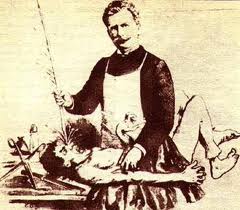
Ambrose Bierce demonstrates his piercing wit

My review of San Diego Symphony principal bassist Jeremy Kurtz’s recital at the Athenaeum has been posted at sandiego.com.
Featuring a special guest appearance by Mr. T and Nancy!



My review of that rara avis: the bebop clarinetist, up now over at sandiego.com
Ken Peplowski, clarinet; Mike Wofford, piano; Tom Warrington, bass; Joe LaBarbera, drums

Musicians have nightmares where they’re on stage trying to produce sounds from an instrument they don’t know how to play. I had a dream that was an especially cruel version of this.
I’m in a theater pit, supposed to be playing a banjo part. It’s bad enough I’ve never picked up a damned banjo in my life, but to make things worse, instead of a banjo, I have a green plastic garbage bag filled with styrofoam peanuts (which oddly are colored orange like circus peanut candy). It’s the dress rehearsal, and I’m able to coax a few pitches out. (Shake a bag of these peanuts, listen to the rustling squeaky sound they make. Now imagine there’s a pitch spectrum you can extract from that rustling, so it sounds like some kind of ghostly gargling melody.) The packing peanut pitches sometimes, but not always, go with the harmony, but I’m playing softly so the conductor can’t really hear the mistakes. As I strum the garbage bag, tears develop and peanuts drop out, but I can still get it to sound.
I somehow manage to get through the rehearsal. We open. (I have no idea what the hell play it was supposed to be). Suddenly, an actor or M.C. on stage points to me in the pit, and a spotlight illuminates me. There’s a very awkward pause–I’m supposed to speak a line, and everyone is waiting for me to deliver it. I wing it and stand up, face the audience, hold my arm out wide in a gesture of welcome, and loudly announce, “Damen und Herren, die Dreigoschenoper!”
I soon discover that wasn’t right, because the actors are glaring at me, but the audience doesn’t catch on. I play through the first act on my styrofoam peanut bag, and I make horrendous mistakes, and the peanuts fall left and right out of the bag.
At intermission, the director, who happens to be Des Macanuff, comes up to speak to me backstage. Now, I did two shows with MacAnuff in the early ’90s, and at that time he was a brilliant, creative guy, fun and pleasant enough to be around when everything worked for him; but when he didn’t getting what he wanted, let’s just say the dude had a major temper.
So here comes Des. I’m waiting to get a new asshole torn, and he’s very somber, but not at all mean. He says matter-of-factly, but with a definite hint of irritation in his voice, “Christian, it’s not working. You’re not even playing a banjo, and that’s what you were hired to do.”
I try to convince him that I can do the part, but Des shakes his head and tells me that he has to let me finish the show tonight, because it’s too late to get a ringer, but I’m not working there ever again. I’m happy that Des isn’t screaming at me; I agree that I need to quit, but I’m also deathly ashamed that I couldn’t play the part and I’ve embarrassed him and ruined the show for everyone involved.
Dreams intrigue me. I don’t know what they mean, and I don’t try to seek meaning; but they do amuse and entertain and scare me, so I respect them.
Are dreams just my brain cranking out random thoughts? Are they coded messages from my subconscious? I tend to believe more the former than the latter.
I’ve begun trying to write down my dreams while they’re still fresh in my mind. The longer I wait to capture them, the more elusive they become. So welcome to my dreams. If you are a guest in them, don’t be alarmed–I’m just reporting here, not making any analyses or assumptions. If it doesn’t make any sense, or ends abruptly–it’s a dream, dammit!
The dream: I try to call my old friend Joe on the telephone. [In real life, I haven’t seen Joe for over 30 years or more, but I’ve been in touch over the years by phone and email and the internet. He is currently a Literature professor at a college.] I dial his office number, but am puzzled to have it answered by a female voice.
“Hi, is Joe there?” I ask with uncertainty.
“No, she’s not here. Would you like to leave a message?”
She? What the hell? I’m positive that was Joe’s office number I dialed.
“Um, sure, tell her to call Chris Hertzog back when she gets in.”
“All right, I’ll do that. Thank you.”
The woman hangs up, and I’m left holding the receiver, trying to puzzle out my old friend Joe’s sudden change in gender. The only thing that makes any sense at all is that Joe had a sex change operation. But wait, I checked his–I mean her–Facebook page the other day, and Joe was married to a woman.
So–the only possible answer is that Joe had a sex change operation, even though he was attracted to women, because he (she?) was really a lesbian. Problem solved.
 I didn’t even submit anything to the San Diego Press Club this year, but I took second place in the category of Daily Newspapers and Websites: Reviews.
Unbeknown to me, my editor, Ron Donaho, nominated one of my stories for a Press Club award and it won. You have to drill down to p. 4 of the 20 pages of awards listed to find the prize notice.
Now if the Press Club could only spell Pat Metheny’s name and the title of his tour properly. Pat Methney? Oh yeah, don’t you know his sister: Crystal?
And if you read the story past the first four paragraphs, you’ll see that the only person on stage was Pat Metheny–sorry, no orchestra. I do mention the word, “orchestrion,” six times though.
What am I going to do with all my prize money? I’m going to buy a chimpanzee and have a tuxedo custom-sewn for him which he will have to wear all the time unless he’s sleeping. Then I will teach him to smoke a cigar. Nothing like a well-dressed chimp with a stogie to add a little class to your life.

The award I won for my review, "Pat Metheny: Orchestrion on Tour"
 Apparently I’ve been banned. From answering Facebook Questions, that is. And right after someone marked the story of my favorite free thing last summer as “helpful.” Suddenly all my answers have been hidden from view from the public, with this message at the top of each of my answers:
Your answer was marked unhelpful and is currently only visible to moderators and yourself
What’s so irritating about this is that out of the 23 Facebook Questions I answered, 12 of them–over half–were serious answers. (Yes, I really would like to see a movie made of Axe Cop). One of those, discussing the difference between film and painting, was marked “helpful” by 9 people. Other of these 12 earnest replies received a number of “helpful” ratings, including a friendly guide to freshwater fishing in San Diego.
Humpph!
Well, the other 11 answers were pretty funny, I thought. I posted 3 of them yesterday. Here, for the sake of public elucidation, are my other cruelly censored Answers to Facebook Questions:
Q. When will the Rancho Cucamonga location of Todai open?
A. When everyone in Rancho Cucamonga is inoculated against salmonella and botulism.
A. VHS does a documentary about your downward spiral and ultimate demise. Your heirs squabble over the ridiculously little amont of money you were able to leave them. Then you are forgotten, like 99.999999999999 percent of the people who have lived on this planet.
Q. Anyone have any recommendations for fun things to do in Cincinnati over Labor Day weekend?
A. When in Cincinnati, you must have one of their famous bow ties. http://tinyurl.com/y29bdzp.
Q. What is revealed to a Scientologist at level OT V?
A. If I told you, David Miscavage would have to kill you, and then force me to salute his beagle 888 times. http://tinyurl.com/ygp2px4. (rated “helpful” by 2 people!)
Q. Who is “All In For Michigan!”?
A. You misheard the saying. It’s “Allen: For Michigan.” Allen van Houten considers himself the biggest Wolverine fan alive. He has attended every home game since 1954, and now that he is retired (he used to own Dooley’s in Ann Arbor), he travels to every single away game the Wolverines play. You may have seen him at games, wearing his wolverine-skin cap, one half of his face painted blue, the other half maize, and his adamantium claws protruding from his blue gloves with bright maize Ms.
Q. What is the most effective commercial you have ever seen?
A. That would have to be this old Public Service Announcement, VD is for Everybody. With a catchy melody I can still hum years later, I learned that anyone–young, old, male, female, upper class or construction worker–can have an STD; so always use protection, especially with a new partner! It’s a far more important lesson than what brand beer to drink or computer to purchase.
Q. What is 10 times 30 minutes? A) 3 hrs B) 4 hrs C) 5 hrs D) 6 hrs.
A. This is an order, not a question. If you want to order something, go to Amazon.com. (3 people marked this “helpful”)
Q. What’s the coolest free item you’ve received this year and how did you get it?
A. That would have to be the amazing afternoon I spent in the company of movie star Jessica Alba.
I was working as a customer assistant at San Diego Hardware. I turned the corner into Aisle 5, and practically bumped right into Jessica Alba. She was wearing flip flops, Daisy Dukes, and a bikini top, just like the Katy Perry song. She was staring down at an angle bracket, biting half of her lower lip, her brow wrinkled with confusion, so I asked if I could help her.
She said, “I need to fasten this to a wall and I don’t know how to do it.”
I said, “Oh, you need to use a fastener.”
She looked up hopefully at me, eyebrows raised, and I asked her, “Would you like a screw?” Her eyes narrowed and she flashed an inviting smile at me and said, “Yes!” and then before I could reply she grabbed my hand tightly and walked quickly out of the store with me in tow.
I was so flabbergasted, I couldn’t speak. There was a 16-foot limo double parked at the curb outside the store. Jessica swung the door open quickly with her free hand, and yanked me into the limo with the other.
Modesty forbids me from describing what happened over the next 2 hours. When I returned to the store, legs shaking, drenched in sweat, ripe with the smell of Jessica’s womanhood intermingled with an odor of pancake batter, my manager was waiting by the register with a security guard. He fired me on the spot–for theft. You see, when Ms. Alba tugged me out the door, I had her angle bracket and a #8 wood screw in my hand. I dropped them in the limo when my hands were needed for other more urgent purposes, and in the daze following my encounter with Jessica Alba, I left them in the car.
Mr. Donaldson refused to believe my story and asked for my apron and name tag and had security escort me out of the store. But those 2 hours in the limousine with Jessica–that was totally cool! Best present ever! The blisters which subsequently appeared on my pecker, however, are another matter. I wish I had listened to more closely to this Public Service Announcement.

Hmmm. Maybe that reference to the “odor of pancake batter” was going a little too far.
[Part One of this Bloghead blog thread may be read at this link]

 Bloghead