
Dr. Eric Lyon asks, "Do you have now, or have you ever had, Typhoid?"
The people have electronically spoken, and we have listened! So many page hits on a previous Eric Lyon review, that I am posting more Eric Lyon reviews. You have to scroll down a bit to get to Eric’s piece, but trust me, it’s worth the wait. I must admit that, nearly 2 decades later, I still have a firm sonic image of Eric’s work Typhoid in my head, including the melody I allude to. It’s the only piece I reviewed below to which I can honestly make that claim, and I haven’t heard it since the festival!
This review originally appeared in the La Jolla Light on May 27, 1993.
To christen a festival Music Frontiers this late in the 20th century is self-deluding; it blithely ignores that the most important musical explorations this century took place from roughly 1910 to 1930, and once again from 1950 to 1970. While a healthy portion of music from this latter period appeared on the series of concerts that took place at UCSD from May 12 to May 15, the implication of this title is that the more recent compositions are somehow blazing new trails.
But the territory these recent pieces occupy is no longer frontier; it is more akin to redecorating or touching up a room in a crumbling, old house in an overly developed community. Significant, beautiful works of art can still be produced in such a situation; but to believe oneself a Daniel Boone when the roads have already been paved years before is an onanistic con game.
And to insist, in this era of bountiful diversity, that music which is the offspring of the experimental, Modernist tradition, is the “best” music one can listen to and perform—the unspoken inference of this festival—is ideological fascism, not too philosophically distant from the idea of a “Master Race” or of “One, True Religion.”
I was able to attend four of the five concerts offered, devoted to UCSD faculty and students who have recently attended the Darmstadt International Courses for New Music, and to European composers who have been prominent there. The town of Darmstadt sent UCSD a musical present in the form of an exceptional string trio, the Trio Recherche from Freiburg.
Unfortunately, the musical excellence of this group was wasted on the compositional poverty of their repertory. Only two of the eight works they performed were pieces I would willingly listen to again—Ernst Krenek’s String Trio (1949) and James Dillon’s String Trio (1990).
Dillon’s trio stood out in its concern for perceptible motives and developmental processes, things the other European composers seemed uninterested in (with the exception of Klaus Huber’s overly long transpositio ad infinitum). The trio had an aggressive dense surface; there was plenty of musical information here, but it did not strain human cognitive limits. Another notable feature of this trio was its strong momentum, again an aspect lacking in so many of the festival offerings.
Krenek’s String Trio was the best offering on the Saturday night concert. Although the sacred name of Webern was intoned in the unattributed program notes, the broad Expressionism of Schoenberg and Berg, and their more robust sense of Classical forms were more obvious influences.
On the same concert, Brian Ferneyhough, the spiritual godfather of Darmstadt these days, received the American premiere of Terrain. This was conceived as a solo vehicle of the brilliant violinist Irvine Arditti, also present at UCSD courtesy of the town of Darmstadt.
While Ferneyhough writes that Terrain is also an homage to Varese (the accompanying ensemble is that same one used in Octandre), the musical language was quite removed from Varese’s incisive colors and rhythms, his clear, bracing harmonies, and his obsessive motives. Above all, Terrain was a demonic concerto for Arditti. Arditti’s eyes were glued to the music, his legs, torso, and head motionless, while his bow tore back and forth unevenly, and his left hand jumped on the fingerboard like a spider overdosed on caffeine. The nervous, agitated torrent of notes spewing from his instrument made him seem like an antique performing automaton gone out of control.
This piece remained a cipher to me; there was too much information to assimilate. Nevertheless, the surface was intriguing enough to invite subsequent hearings. Rand Steiger led SONOR in what seemed like a tight performance, no small task considering the music often changed tempo every measure.
Flautist John Fonville, pianist Alec Karis, and percussionist Steven Schick gave an exquisite reading of Morton Feldman’s Crippled Symmetry. Feldman’s delicate 90-minute opus was powerful proof that profundity can be generated through extremely simple means—in this case, a four-note motive varied and permuted in all the instruments throughout the entire piece.
On the first night’s concert, Harvey Sollberger led a 24-piece orchestra in a rousing interpretation of Nono’s Incontri, a Golden Oldie from 1955. Incontri is a work which both thunders and caresses; Nono, unlike many of colleagues at Darmstadt, was concerned with emotional directness.
Stockhausen’s Kreuzpiel, from 1951, on the other hand, is a strange, self-contained world, one in which the operating principles are not apparent, but whose processes nevertheless fascinate us.
One could say the same thing about UCSD student Philippe Lierdeman’s brief Variations for Wind Quintet, composed this year. But where Stockhausen’s world seems a strange synthesis of Germanic serialism and African music, Lierdeman’s blocks of parallel chords betray an obvious French influence. However, the angular melodies and the constantly shifting rhythmic layers again intrigue us in spite of (and perhaps because of) the obscurity of their generating procedures.

"Typhoid" Mary
Eric Lyon’s Typhoid for violin and tape was the only work on the festival that displayed a sense of humor. Typhoid was composed for Mary Oliver; she gave it a wonderful performance, alternately abrasive, seductive, naïve, and funky. Typhoid is one of Lyon’s earlier endeavors into what he calls “the New Sensitivity;” it is a musical Cuisinart combining 1960’s analog tape pieces, Bing Crosby, industrial music, and possibly one of the most gloriously stupid melodies Lyon has ever written.
While the quality of compositions ranged from very good to abysmally awful, the level of performances was consistently high; every performer on these concerts deserves praise. One hopes that there will be more festivals like this in coming years—and wish that the level of the compositions is as high as that of the performances.
Brad Mehldau took his good old time starting his concert at the Neurosciences Institute on March 31, 2010. So I tried to sketch the Steinway piano sitting on the stage before he came out:
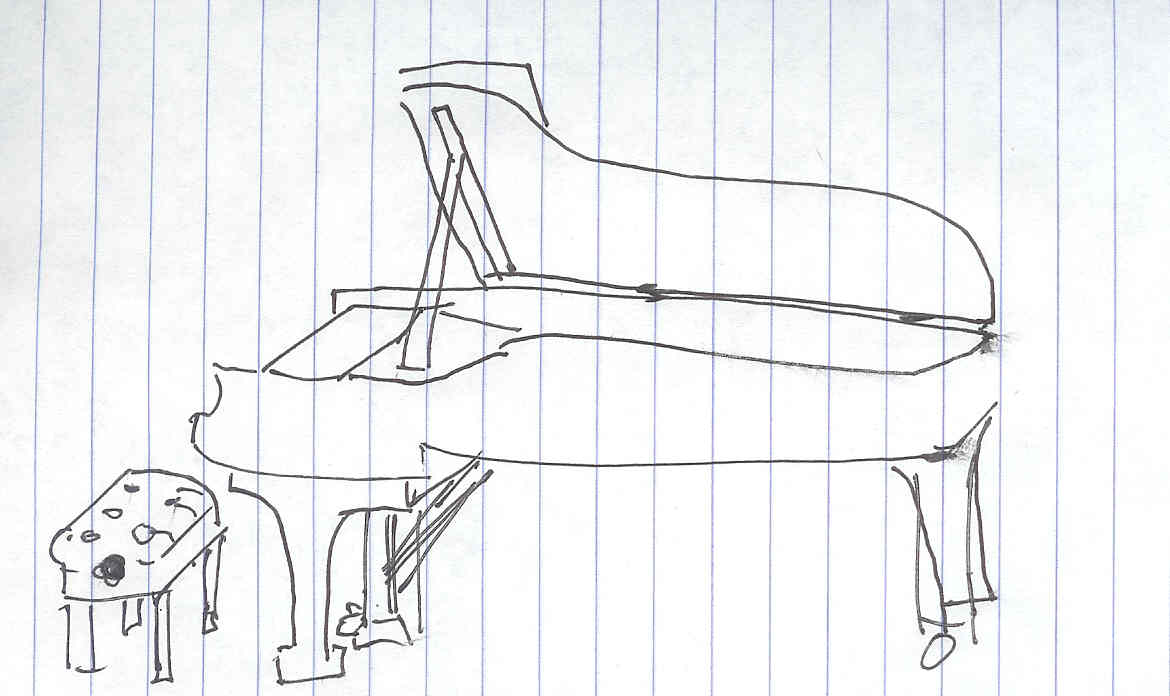
Steinway grand piano, Neurosciences Institute, San Diego, Brad Mehldau concert, March 31, 2010
For my review of the concert, click here.

Gerald Clayton
I caught the Gerald Clayton Trio at the Athenaeum last week–wonderful group, astounding musicality for their youth. They are well worth your time and money should they come to your town. More here.
If you go to Amazon.com and read the customer reviews for cartoon collections by the guy who draws The Family Circus, Bil Keane, you will come across smart-ass reviews written in the style of English Lit majors or New York Times book reviewers. I’ve always been tickled by these, so when I came across a Bil Keane book that had no customer reviews, I decided it was time for me to flex my muscles in this obscure field of humorous writing.
Since the party-poops at Amazon.com removed my effort, here it is now for your edification. If the story seems vaguely familiar, I wrote this essay shortly after the Terry Schiavo incident with the Republican party in 2005.
Amazon customer review of Are You Awake, Daddy? by Bil Keane
Title: A compelling argument for the legalization of euthanasia
An easy-to-read and insightful comic strip analysis of the intersection of modern medicine and ethics. Daddy drives back from a bar humorously named “The Office” after having a few too many tall cold ones. Confused by the large black dotted lines that appear on the street (ironically, they were left behind the trail of his son Billy as he followed a cat around the neighborhood), Daddy swerves suddenly and crashes into a tree. He winds up in a coma (the scene where Dolly tugs at her father’s inert wrist with tears in her eyes is where the title comes from). Billy is visited by the ghosts of his grandparents, who inform him that they want Daddy to come home to them, but his persistent vegetative state prevents that.
After attempting to end Daddy’s artificially supported life, preachers, congressmen, senators, and even the leader of our country intervene in a misguided attempt to prolong Daddy’s life. Billy, who is now the man of the house, realizes that the burden of putting an end to Daddy’s misery lies on him. Recruiting Dolly, P.J., and Jeffy to distract the doctors and authorities (P.J. starts crying in the hallway “I did a number 2,” Jeffy pulls a fire alarm, and Dolly runs around naked crying that a preacher attacked her), Billy is able to pull the plug on Daddy. In the last page, we see the ghost of Daddy embracing the ghosts of Grandpa and Grandma, while Ida Know and Not Me happily stand by on the sidelines.
Mr. Keane once again tackles the most profound issues of contemporary American life with astonishing ease and wisdom. The fact that this masterpiece was passed over for the National Book Award, the Pulitzer Prize, and the National Critics Award demonstrates how out of touch the New York literary establishment is with the rest of America. How lucky we are that the Nobel Prize committee recognized Mr. Keane with their Literature Prize, confirming what the rest of the world has been asserting for years: Bil Keane is America’s greatest man of letters.


Now I lay me down to sleep,
I pray the Lord my job to keep.
If my boss comes before I wake,
I pray the Lord his life to take.
If the most talented and creative American composers were rewarded by commissions, performances, and recognition, Eric Lyon would be at the top of the heap for my generation. There are few composers I have known whose talent dazzles me the way Eric’s does. The man is a genius, and the shameful neglect of Eric’s work is proof that the American music establishment and academic system are dysfunctional.
I wrote ecstatic reviews for most of Eric’s work that I heard in concert. No arts administrators ever contacted Eric about a commission. Had he been given a high-profile residency with an orchestra or ensemble, I’m convinced he’d be a tenured professor at a prestigious American music school and/or in demand for new works by the most talented performers and organizations in the business. But Eric never got that lucky break. He moved from San Diego to Japan to Dartmouth to Manchester to Belfast over the last 15 years or so, while less-talented but better connected classmates of his found career stability and relative success.
At the end of this review, which originally ran in the La Jolla Light on May 20, 1993, I claimed that Eric’s music was the most consistently exciting and enjoyable music of any San Diego composer. For the sake of comparison, at the time that would have included Roger Reynolds, Joji Yuasa, and Brian Ferneyhough. In fact, given a choice today between listening to a new work by Eric and any of those three gentlemen, I would be most enthusiastic about hearing the new Lyon opus.
Unfortunately, I don’t find Eric’s recorded output his strongest work. The music of his I enjoy most are his larger ensemble pieces and his chamber music for soloist or chamber group and computer music. He’s working on a big piece for Kathy Supove for piano and electronics, which has the potential, given Kathy’s visibility in the new music world, to be a breakthrough work for Eric. Let’s hope so.
On tape or in the flesh, Lyon’s music provokes
 Eric Lyon came to San Diego in the mid ’80s with some of the most gleefully malevolent music I had ever heard. It was obsessive and violent. His tape pieces were played back at volumes so exceedingly loud that most audience members tightly covered their ears. To pour salt in the wound, these tape parts were often filled with rude, cruel sounds, as if Lyon had gone out of his way to create the most grating timbres he could electronically summon.
Lyon has always been a provocative composer. But over the past seven years his language has evolved into something he dubs “The New Sensitivity.” In his recent works, the materials themselves are not as unsettling as his forms, created by juxtapositions of seemingly unrelated elements.
The surface of his recent music is frequently quite pleasant, but the underlying syntax is disturbing. Any given measure may have the veneer of Classical or popular music, but the melodies and harmonies operate in a seemingly arbitrary fashion. Unrelated styles are butted and interwoven to create musical edifices that threaten to collapse from the extreme differences in materials, yet miraculously stand tall, mocking the modernist ideology of stylistic purity.
Lyon never simply evokes a style; he grotesquely parodies it. Nothing is sacred to him. He skewers contemporary European complexity as readily as he does 1960s pop music, 18th century Classicism, or hip-hop. The entire history of Western music and the plurality of music overcrowding the radio airwaves are simply source material for Lyon to distort.
On May 6 Lyon presented a concert of his recent works (three of them local premieres) at the Center for Research in Computers and the Arts on the UCSD campus. Before the concert, Haydn string quartets were played over loudspeakers as background music. This set the irreverent tone for the opening work, Lyon’s String Quartet No.2 with Computer Generated Tape.
The performers (Arun Bharali and Erik Ulman, violins; Conrad Bruderer, viola; and Enjoo Lee, cello) strode out amidst the onstage loudspeakers, electronic equipment cases, lava lamps, and the sleeping bags in the aisles, dressed in concert black and looking as if they had arrived at the wrong address for their gig.
The piece opens with a sample of a string quartet firmly playing a major triad, answered by the live quartet. The tape and quartet then trade off triads as if competing with each other. After this musical conf1ict, a few eerie washes of computer music momentarily shove aside the Classical music references, and soon an electronic pulse presages an extended dance section in which the tape functions as a hip-hop rhythm section, while the string quartet plays in a naive Classical style reminiscent of the string arrangements George Martin did for the Beatles. The difference in Lyon’s music is that there is never a firm sense of tonality; although he uses simple triadic figures and major scales, his cadences occur unpredictably, and the harmonic progressions are meaningless in a traditional sense.
Lyon’s genius lies in his ability to throw all of these disparate elements together and somehow make them work. As the quartet progresses, Lyon also mixes in 1960s psychedelic music (while the string quartet makes a brief allusion to the nursery tune “Rock-a-Bye Baby”), Industrial music, and a quaint section featuring archaic Columbia/Princeton electronic music studio sounds while the quartet trots out all of the “new music” cliches: loud staccato pointillism, sul ponticello notes, brief tremolos, and scratchy down bows.
The performers gave this piece a competent reading, yet it sounded too much like the quartet did not truly feel comfortable with this piece. One wished that the musicians could have been amplified; far too often they were over-shadowed by the tape part. Nonetheless, one is grateful for the opportunity to hear this work live; it is one of Lyon’s most striking pieces.
Lyon writes for the computer the same way that Ravel or Mahler wrote for the orchestra. His technique is virtuosic; there is apparently no sound he cannot produce. He is fond of taking outrageous source material–such as a grunt from a pornographic tape, or a suicidal gunshot–and using it, without reference to its origins, as just another sample to be manipulated. Unlike many computer music composers, whose tape parts are textural washes in which a performer swims around or plays against, Lyon’s tape parts aggressively interact with the live musicians. Motives pass from performer to tape, and vice versa.
This is not simply a matter of the tape playing strictly notated pitches. At one point in Paradigms II: In A Field Of Turnips, there is a rising and falling glissando in the tape part which the alto flute accurately imitates. John Fonville was the soloist for this work; unlike the quartet, Fonville knew his part inside and out. (This was the second performance.) The balance between performer and tape was much better here.
Paradigms II: In A Field Of Turnips is another blend of groovy ’60’s feel-good music, hip-hop, and nostalgic RCA Mark V synthesizer sounds. Instead of dissecting Classical music, Lyon takes apart the avant-garde flute tradition. There is also a swipe at UCSD composers who write pieces for soloists playing against a multi-track recording of themselves.
Greaseball pits an electric guitar against another virtuosic tape part. Lyon concocts a heady fusion of heavy metal, underground art-rock, contemporary dance music, and late-20th century concert music. John Stevens was the appropriately greasy guitarist.
The oddball in this concert was Paradigms III: Sign Language, for solo tape. It is one of those slow, spacy electronic pieces in which time is stretched out so successfully that one cannot tell how long the piece is: Was it 8 minutes, or 30? (I think it was somewhere around 25.) While this was unarguably a good piece, it displayed little of the manic invention apparent in the other three works on the program. Instead of making fun of Modernism, it was played right along with it. As one of my friends commented, “Eric, it sounds like you’re trying to get a job somewhere.”
Lyon himself seemed to realize this; he had to resort to turning on lava lamps and burning incense to put enough irony into the work. Still, there are few composers in San Diego who could put together a successful concert of their own works. As this concert demonstrated, when he is on target, as he was in his performer and tape pieces, there is no more exciting, enjoyable local composer.
This was a nice precursor to my current reviewing style. I couldn’t publish a story like this in the Union-Tribune, but my editors at the Light gave me free rein as long as I didn’t diss any potential advertisers or use naughty words.
This appeared in the La Jolla Light ca. May-June 1994. (I don’t have the original clipping, so I don’t know the exact date.) Not too long after this was published, just as I was starting to find my own voice as a critic, Rupert Murdoch bought out the La Jolla Light and canned my ass. I suppose those two orchestral premieres did have a negative effect after all, although I was able to take this review and use it to land a $1000 article on UCSD composers and performers (the biggest paycheck I ever received as a writer).
By all indicators, the End of the World should have happened last week.
First, Steven King’s The Stand was shown on TV to whip everyone into an apocalyptic frenzy. Next there was a solar eclipse. Then, on Friday the 13th no less, Yoav Talmi and the San Diego Symphony gave the long overdue local premiere of Roger Reynolds’s Dreaming.
As if all this were not enough terrible strain on the cosmic fabric, the next evening the La Jolla Symphony and Chorus performed Harvey Sollberger’s Passages. Two orchestral works by local composers on the same weekend! I don’t know about you, but I cashed in all my stocks and bonds, sold my baseball cards and Krugerrands; spent half the money on canned and dry goods, and the rest on automatic assault weapons.

"Why, oh why did they have to play all that modern orchestra music?"
Imagine my confusion when Monday rolled around and Communists had not overthrown the government, Wall Street did not lay in ruins, and the seven angels from Revelations were not dancing a Broadway-chorus-girl kick line in the sky.
When Dreaming was cancelled by the San Diego Symphony last year (the official reason being that Reynolds had not supplied parts well enough in advance), the world premiere defaulted to the New-York-based American Composers Orchestra in January 1993. A tape of that revealed intonation and ensemble problems. In contrast, Talmi and the SDS gave the work, as near as I can tell without a score, a tight, accurate reading; I doubt any of the other groups that co-commissioned Dreaming gave or will give the piece as good a performance as we heard at Copley Symphony Hall.
Dreaming takes it inspiration in general from the process of dreams, and specifically from four literary fragments by Borges, Wallace Stevens, and Coleridge. Many of Reynolds’s recent large ensemble works deal with a soloist and/or a group of soloists (a concertino), and their relation to the rest of the orchestra. While stagehands reconfigured the seating for “Dreaming,” Reynolds gave a brief talk, comparing the 12-instrument concertino to a community, the soloists as individuals within that community, and the orchestra as a “mythic society,” a Jungian collective unconscious.
One speaks of images and ideas resonating in our culture, and this is exactly how Reynolds treats the orchestra in the first two movements, sustaining isolated notes from a stream played by a clarinet trio in the first movement and by two mallet percussionists, piano and harp in the second. It seemed a successful attempt at orchestrating the grandiose reverberation Reynolds favors in most of his electronic works.
Reynolds has a reputation as an experimental, visionary composer, but Dreaming often seemed curiously old-fashioned, its lush orchestral textures harking back to Berg. There was little of the aggressive, disjunct surface presented in Reynolds’s chamber music; Dreaming does roar and howl at the climax of the third movement and throughout the fourth, but with a luxurious sonic directness, a new development in Reynolds’ language since the late ’80’s. Alex Ross in the New York Times identified this as neo-Impressionism, and indeed, my companion, unprompted by Ross or myself, heard a Debussy influence in Dreaming.
The avant-garde side of Reynolds appeared in the third movement, when a surprise tape part adds the roar of surf to the waves of crescendos in the brass. (The tape part, effective as it is, sounds like it was recycled from Reynolds’s Version Stages.) The mournful glissandos of the solo oboe in the fourth movement, invoking Coleridge’s “woman wailing for her demon lover,” were elaborated by woozy string and brass lines, punctuated by violent tympani bursts.
As good a work as Dreaming was, Sollberger’s Passages impressed me even more. Guest conducting the La Jolla Symphony and Chorus, Sollberger oversaw a sympathetic performance of his work, aided greatly by soloists Philip Larson (bass), Patricia Minton (soprano), and John Fonville (flute).
Passages was composed at the American Academy in Rome; Sollberger wanted to write a specifically American work for his European audience. Tapping into the transcendentalist tradition, he chose texts by Whitman, Thoreau, and a traditional Modoc Indian song.
There are two qualities that distinguish American music. One, which has been identified by many critics, is stasis; foreign commentators such as Wilfrid Mellers point to this as an attempt to evoke America’s large, open spaces. You can hear this dismissal of harmonic motion in Ives, Copland, Feldman, Reich, and Cage. The other quality is a rude but happy boisterousness; this was apparent in two other works on the program, Revueltas’s Caminos and Ives’s General William Booth Enters Into Heaven.
Sollberger’s work embraced both of these aesthetics in the bouncy asymmetrical rhythms of the first movement, and in the meditative, introspective sections of the second, such as the pretty diatonic repetitions that accompanied the words “vast surrounding.”
Sollberger presented his texts in juxtaposition, an effective musical translation of the all-embracing nature of American transcendentalism. Sollberger takes four different texts, and unites them in one grand vision through his music. It is a successful musical summation of Whitman’s lines, “Do I contradict myself?/ Very well then I contradict myself.! (I am large, I contain multitudes).”
If there’s a moral to this review, it’s that new music won’t hurt you. Contrary to popular belief, contemporary classical music does not cause incurable diseases or produce mutated offspring. New music does not make people homeless or unemployed. At its worst, it will merely confuse or bore you, and at its best, it will enrich your soul and rejuvenate the cells in your brain that rot away every time you flick on the television. There’s plenty of room for more contemporary orchestral music in this town, and we have composers who live here who are up to the task of writing it.
By the way, if anyone is interested in buying 23 gross cases of Spam, contact me care of this paper. If you’re looking for an Uzi or an AK47, leave your name and phone number in a pink envelope in the second dumpster on the right behind the Light’s offices.
This was an assignment for the San Diego Union-Tribune, published March 1, 1995. Rather than allow me to do separate reviews of each concert (which would have permitted me to discuss all the works on each program), my editor at the U-T wanted me to consolidate both concerts into one review, which forced me to focus on the most review-worthy works for each show and drop the others. As it turned out, these 2 events were the most noteworthy performances of the Festival (along with red fish blue fish’s performance of Drumming by Steve Reich). Everything else dissolved in a blur of high modernist works.
The appearance of BOAC All-Stars and the Paul Dresher Ensemble was very controversial at UCSD. Sources told me that Roger Reynolds vowed to composition students that the UCSD Music Dept. would never present an ensemble like BOAC All-Stars again. This was the first time Paul Dresher had returned to the UCSD Music Dept. (he had done a production of Slow Fire courtesy of the Theater Dept. before this–but heavens forfend the Music Dept. present an opera with tunes you could dance to). I was told this review hurt him deeply, which didn’t make me happy, as I like Paul Dresher (the few times I’ve met him) and his music; in the years since, his ensemble has reached its potential for exploring music for electroacoustic instruments, but in this early concert of theirs, the gap between intent and realization was still apparent.
For comparison, check out Kyle Gann’s write-up of the Festival in the Village Voice, March 21, 1995, p. 74.
True to its title, the Emerging Voices Festival at UCSD brought two young, prominent groups to Mandeville Auditorium this weekend: the Paul Dresher Ensemble played Friday night; the Bang On A Can All-Stars, Saturday evening.
Both acts perform repertory influenced by rock and jazz. Both seek to redefine chamber musk through electronic amplification. But there the similarities end.
The Paul Dresher Ensemble was terribly disappointing. Most of the repertory was boring and displayed an unimaginative use of the ensemble’s instrumentation (violin, bassoon/clarinet, two electronic percussionists, piano/electronic keyboards and Dresher himself on keyboards and electric guitar).
The Bang On A Can All-Stars, by contrast, were the high point of the festival thus far. Their selections were strong and thoughtfully composed for the group (Evan Ziporyn, clarinets/saxes; Mark Stewart, electric guitar; Maya Beiser, cello; Lisa Moore, piano; Robert Black, contrabass/electric bass; and Steven Schick, percussion). In addition, the solo and ensemble performances were beyond reproach.
New York’s Bang On A Can Festival embraces a wide range of contemporary musical styles, but the All-Stars promoted one particular aesthetic. The works written for them displayed a steady pulse, a fundamental underlying tonality and a conscious attempt to synthesize popular music and 20th-century compositional techniques.
While many pieces heard on the Emerging Voices Festival could have been written 20 to 30 years ago, the All-Stars’ selections were unmistakably stamped by the present time and culture.
David Lang’s Press Release rapidly jumped between the high and low registers of the bass clarinet to create the illusion of two melodic entities. Audacious in its unrelenting exploration of this virtuosic compositional device, Press Release was a humorous piece shamelessly displaying Lang’s fondness for James Brown. Ziporyn gave the work a witty, persuasive reading.
In Horses of Instruction, Steve Martland threw an unending stream of eighth notes with tricky, shifting accents at the All-Stars, who negotiated this treacherous music with unswerving ferocity.
Nick Didkovsky worked with automatic composition software to produce the nine movements of Amalia’s Secret. Unlike the program’s other ensemble works, Amalia’s Secret had moments of extreme quiet and introspection. Much less obsessive than the other offerings, it was a curious assortment of odd textures and melodies that veered off on unexpected tangents, at times fascinating, at other times perplexing.
Judging from her recorded works, Julia Wolfe is much closer to mainstream musical thought than her colleagues on this program. But in Lick, she rocked with the best of them, showing a few tricks with her displaced rhythms and stabbing chords. Balances seemed unclear during tutti sections, but more than any composer that evening, Wolfe captured the brusque vitality of rock ‘n roll and transformed it into something ear-opening.
The Paul Dresher Ensemble had a more sophisticated electronic set-up than the All-Stars. But the arrangements (five of the nine pieces were transcriptions) revealed a lack of ingenuity. What’s the point of arranging a piano or percussion part to sound like sampled piano or percussion (as Dresher did in Double Ikat)? It simply makes the electronic instruments bad imitations of acoustic instruments.
Of the three works commissioned for the ensemble, only Bun-Ching Lam’s Qin 2000 displayed a combination of compositional chops and orchestral flair. Qin 2000 begins with unamplified acoustic instruments, written in a sparse, dissonant vein, and gradually becomes a bona fide rock orgy, which then subsides into a melancholy duet between a sampled Chinese string instrument and a violin processed to sound forlornly distant and thin.
Carl Stone, known primarily for his electronic music, used a computer to process an 18th-century piece in Ruen Pair. These results were converted into a score for live players, and while there were some intriguing moments, the unchanging textures quickly became monotonous. Dresher’s Din of Iniquity displayed a sure sense of orchestration, opening with long, sustained guitar notes, and concluding with a gratifying, rock-inspired guitar solo. But the form of the piece was clunky, the transitions unconvincing, and the drive to the final climax improperly paced.
One came away from Dresher’s concert brooding over the tremendous gap between the ensemble’s potential for exploring new territory and its dismal failure to realize this goal. Happily, one left the Bang On A Can All-Stars invigorated by the positive vision of an innovative chamber ensemble and a vital, original style of composition.
An incomplete review of a concert by Woody Allen’s jazz band at Copley Symphony Hall in December 2006. I regret not being able to publish this review because the title is a pun on an obscure 19th-century popular song.

The Woody Allen Band--not sure where this photo was taken, but it looks like the same contingent I saw at Copley Symphony Hall in Dec. 2006
Band: Woody Allen, clarinet; Eddy Davis, banjo; Conal Fowkes, piano; Simon Wettenhall, trumpet; Jerry Zigmont, trombone; John Gill, drums; Greg Cohen, bass.
Woody Allen’s Dixieland band is anchored by a veteran master of the forgotten art of jazz banjo, musical director Eddy Davis, who kept the rhythm jumping. Many of his players sport impressive credits—Greg Cohen is also Tom Waits’s bass player and plays in John Zorn’s band, Masada, and in other Zorn projects. The musicians’s solos were of variable quality, but occasionally they struck fire—particularly some crackling work by Australian trumpeter Simon Wettenhall and outbreaks of fancy stride piano by Zambian-born Conal Fowkes.
Their huge repertoire ranged all over the old-timey spectrum, with frequent incursions into gospel (“Over in the Glory Land,” “The Old Rugged Cross,” “Down by the Riverside”), a tune Bob Wills put his stamp on (“Corrine, Corrina”), and novelties like “Aba Daba Honeymoon.” No tune was too humble or homely for them — even “Home, Sweet Home” or “Listen to the Mocking Bird.”
Allen remains a throwback to an older style of jazz clarinet playing — punching out the notes, peppering his passages with smears and other rubbery comic effects. On this night, though, he seemed to have problems with his reeds or perhaps battled an instrument malfunction; with a buzzing tone in the lower register, he sounded as if he was overblowing too much. Oddly enough, he had more success with the faster tunes in the upper register.
Happily, Allen still has the enthusiasm of an amateur in the best sense. When the band came back for encores, Allen stretched the set well beyond the announced 90 minutes, striking up tune after tune after tune, even getting off his best solo of the night.
At the end, he unloaded a line that could only have come from the self-mocking character he created: “You can finally decide for yourself whether my movies are worse or my clarinet playing!”
I am notorious for starting projects (musical, verbal, home repairs) and never finishing them, for whatever reason (too long ago, too lazy, got blocked and didn’t know what to do next). Some of these aborted projects have some merit, so rather than let them die a quiet death, I will post them online here so the whole world can see these stories tragically cut down before they had even really started.
The first is a review of Brian Wilson’s band. They played at House of Blues in Jan. 2009. A Christian rap band opened for them. I didn’t think there could be anything I disliked more than rap music or contemporary Christian music, until I heard Christian rap. Two cocky vocalists yelled in belligerent tones that people needed to love each other and respect each other, all in that clipped, aggressive gangsta style. If ever the word of the Lord was delivered in an inappropriate way, this was it. Praise God I could order a Sierra Nevada to dull my pain. Soon the Christian homeboys strutted off the stage to not be heard from again, their departure being the closest experience I have ever had of God’s infinite love. What follows is what I rediscovered on my hard drive, 18 months later:
The stranger staggered over to me and leaned in close. His eyes were bloodshot and bleary, and his words stumbled out engulfed in a treacly, invisible fog of rum and corn syrup. “They say Brian Wilson is a legend.”
I replied, “Yes, he is.” As if I didn’t hear him the first time, he repeated it to me, and I mumbled my assent once more. The drunk had a good 50 pounds on me, so I put up with his banter until he finally wobbled back from whence he came.
This sort of thing never happens to me at classical or jazz concerts, but I was standing in the middle of a small crowd in the upper level of the House of Blues, listening to Brian Wilson and his band knocking off a rocking version of “Do It Again,” and I suppose avoiding a fist in my face came with the territory of reviewing a band in a bar.
This encounter, however, was a small price to pay to witness Brian Wilson and a 15-piece band perform thrillingly tight versions of pop music treasures such as “California Girls,” “Heroes and Villains,” “Wouldn’t It Be Nice,” “God Only Knows,” and “Good Vibrations” (the latter easily one of the greatest 45’s from the 1960’s). These and 14 other songs made up Wilson’s first set, and what’s amazing, when you step back from it all, was that there was not a single stinker in the lot. Apart from Lennon and McCartney, or Stevie Wonder, what other pop composers could give you 19 beautiful songs like that in a row?
Recognition of Wilson as a genius—yes, that word is appropriate here—probably took longer than it should have. After the Summer of Love, Wilson and the Beach Boys were readily dismissed by many listeners as irrelevant pop music fogies. Their lyrics are a stumbling block for many, too simple-minded or juvenile to merit serious consideration, yet has there ever been a better anthem to teenage optimism in the face of frustration than the simple but real sentiments expressed in “Wouldn’t It Be Nice?” Such feelings have certainly never been treated with such sonic gorgeousness as Wilson did in this song.
His band did a remarkable job of capturing the richness of Wilson’s harmonies and arrangements. Most of them doubled on two or more instruments, enabling them to duplicate or approximate the wide range of timbres that Wilson used in the recording studio. How many musicians do you know that can play guitar, French horn, and Electro-theremin? That’s what Probyn Gregory did. I lost count of the number of brass and wind instruments (plus harmonica—not your typical blues harp, but one of those overgrown, low harmonicas that Wilson was so fond of) that Paul Mertens played, all of them flawlessly.
My unsolicited conversation at House of Blues with the drunk behemoth ended with him slurring, “You know, we’re very fortunate to have Brian Wilson perform here in our town.”
He was so inebriated that I couldn’t tell if he was trying to be sincere or a smart ass.
I replied without the slightest scintilla of irony, “Yes. We are.”
Brian Wilson, lead vocals
Scott Bennett, vibraphone, keyboards
Nelson Bragg, percussion, vocals
Mike D’Amico, drums
Jeffrey Foskett, guitars, lead vocals
Probyn Gregory, guitar, horn, Electro-theremin
Paul Mertens, winds
Taylor Mills, vocals
Darian Sahanaja, keyboards
Brett Simons, bass
Nick Walusko, guitar
SET LIST
California Girls
Girl Don’t Tell Me
Dance, Dance, Dance
Surfer Girl
And Then I Kissed Her
Salt Lake City
When I Grow Up
The Little Girl I Once Knew
Add Some Music
Don’t Worry Baby
Do You Wanna Dance?
I Get Around
Heroes and Villains
Wouldn’t It Be Nice
God Only Knows
Sail On, Sailor
Marcella
Good Vibrations
INTERMISSION
Complete performance of That Lucky Old Sun
Encores:
Johnny B. Goode
Help Me, Rhonda
Barbara Ann
Surfin’ U.S.A.
Fun, Fun, Fun
Love and Mercy

 Bloghead